
A 6-week virtual training for all practitioners who treat pain
For: PT, PTA, OT, COTA, MD, DO, RN, NP, PA, PSYCH, DC, RD, CPT, HEALTH COACH
How Mindful Stress Management can enhance your practice
Evidence based strategies for stress management are not yet commonly discussed or employed by healthcare professionals. Given the current state of the healthcare arena, it is critical that healthcare practitioners have strategies that they can use in real time, practice in the workplace and at home, and share with patients who lack resources to manage the complex emotions associated with illness and disease.
This is consistent with an integrative, biopsychosocial approach to self-care and patient-management that is easily accessible, non-pharmacological, and evidence based. Healthcare providers deserve preventive strategies that promote healthy lifestyles and their patients will benefit from practitioners who listen deeply, make safe and effective clinical decisions, and use psychologically informed, holistic approaches.
Burnout, compassion fatigue, and stress are real concerns in today’s healthcare arena. Mindful practice is a way of being with stress that prevents the cascade of autonomic, metabolic, and neurological events that can harm us. This course will teach evidence based practices that are simple to employ in any situation and have lasting effects on practitioner mental health and emotional well-being.
Course material will include the history of mindfulness and the explosion of neuroscientific research for the beneficial effects of mind-body interventions. It will discuss the neural correlates of the default mode network as compared to the experiential network and it will provide specific and detailed tools for daily practice. Concepts such as burnout, compassion fatigue, conflict, boundaries, and trauma will be covered. Updated research on the body’s neural axes will shine light on how stress affects every body system and how the by-products of stress predict chronic illness and dis-ease. Upon completion of the course you will be able to apply stress management strategies for yourself, your patients, and your colleagues to enhance health outcomes and quality of life.

Patients who are empowered to make decisions about their health that better reflect their personal circumstances experience improved health outcomes.
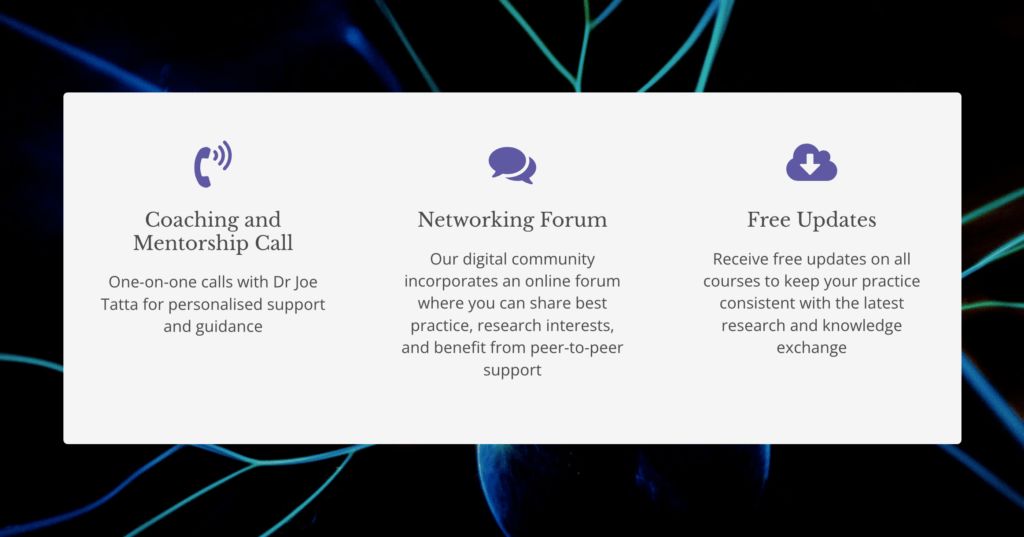
Network with your peers and Dr Joe Tatta, share best practices and research interests. Identify the root cause of patient pain and assess patients and clients holistically.

Evidenced-based strategies and techniques to increase your referrals and generate higher revenues for your practice.

Use the arrows below to expand each section
History of Mindfulness
Mindfulness of Body, Mind, Experience
The Stress Axes and the Practice
Personal Practice
Experiential Training Videos
Handout: Mindfulness & Physical Disease, Greeson & Chin 2019
Practice Doc and Resources
Week 1 Quiz
Research: Neuroscience of Mindfulness
Default vs. Mindful vs. Mindful Mind
Mindfulness, Burnout, Compassion Fatigue
Personal Practice
Experiential Training Videos
Handout Option 1: Physician Anxiety & Burnout, Roy et al, 2020
Handout Option 2: Mindfulness, Compassion, & Self-Care, Coversano, 2020
Week 2 Quiz
Practice for Daily Life: Tools #1-3
Practice for Daily Life: Tools #4-6
Practice for Daily Life: Tools #7-9
Personal Practice
Experiential Training Video
Handout Option 1: A Neurobehavioral Account for Decentering, King & Fresco, 2019
Handout Option 2: Paradoxes of Mindfulness, 2018
Week 3 Quiz
Unpacking Personalities
Boundary Making and Breaking
Conflict: Blame, Empathy, Deep Listening
Personal Practice
Experiential Training Video
Handout: The Answer to Anger & Aggression
Week 4 Quiz
The ACE Study and Resilience Research
Research: Trauma Informed Care (TIC) and Mindfulness
A Case Study
Personal Practice
Experiential Training Video
Handout: Action Steps using ACES & TIC, Leitch, 2017
Week 5 Quiz
Coaching Call Information
Complete Course Survey for CE/CEUs
“I’ve structured the course to keep things sequential and straightforward to assimilate [Dr Joe Tatta]
#1: To define what mindfulness is and is not.
#2: To adopt a contemporary terminology related to stress and the neural circuitry that accompanies it.
#3: To learn, explore, and practice evidence-based strategies that dampen the stress response.
#4: To understand the neuroscience associated with mindfulness, including the brain regions associated with mind-wandering, default mode, and resilience.
#5: To explore the various ways that individuals experience conflict, based on personality profiles.
#6: To explore the concept of healthy boundaries, blame, empathy, and self-awareness.
#7: To explore trauma-informed-care, resilience research, and emotion regulation.
#8: To develop a healthy habit of daily mindfulness practices that take 5 minutes.
Feel free to get in touch using the ‘Contact’ link above if you don’t find the answer to your questions.
Yes! This course is approved for 7 CEUs for PTs and OTs.
The Integrative Pain Science Institute is recognized by the New York State Education Department, State Board of Physical Therapy as an approved provider of physical therapist and physical therapist assistant continuing education. This course is approved in New York as well as more than 34 states through reciprocity (see below for a list of states).
STATES PRE-APPROVED THROUGH RECIPROCITY:
Alaska, Arizona, Colorado, California, Connecticut, Delaware, Florida (Rule 64B17-9), Georgia, Hawaii, Idaho, Indiana, Iowa, Kansas, Kentucky, Maine, Massachusetts, Michigan, Mississippi, Missouri, Montana, Nebraska, New Hampshire, New York, North Carolina, North Dakota, Oregon, Pennsylvania, Rhode Island, South Carolina, South Dakota, Texas, Tennessee, Utah, Virginia, Washington, Wisconsin, Wyoming
This course is also approved by the Texas Board of Physical Therapy Examiners.
NOTE: Some states still do not require continuing education for re-licensure. In addition, some states do not perform verification of continuing education material, which means they do not approve courses for CEU credit and usually accept any material. Please check with your state physical therapy association or state PT board for more details.
For participants outside of the United States or those who do not require a formal CEU certificate, we will be happy to provide a Letter of Participation form that you may keep for your records. Upon completion of the course, please contact us at support@integrativepainscienceinstitute.com to request the form. Please check with your industry governing body to confirm whether this is required for your continuing education.
Registration includes unlimited access. You have as long as you need to complete the program and you can come back to the training as many times as needed.
This is an on-demand program. Each week you will receive new content. The program can be accessed in real-time, anywhere, and at any time. If you fall behind you can catch up at your own pace.
This program requires approximately 1-2 hours per week to complete.
Lessons are available in a variety of formats to make learning easy and fun, including video, audio, transcripts, study guides, PDF handouts and quizzes.
We’ll never share your information
Unlock the Secrets to Effective Pain Care – Download Your Free Copy of ‘The Ultimate Guide to Pain Care’ Now!
Effective Date: May, 2018
Your privacy is very important to us. We want to make your experience on the Internet as enjoyable and rewarding as possible, and we want you to use the Internet’s vast array of information, tools, and opportunities with complete confidence.
The following Privacy Policy governs the online information collection practices of Joe Tatta, LLC d/b/a joetatta.co and www.backpainbreakthrough.com ( collectively the “Sites”). Specifically, it outlines the types of information that we gather about you while you are using theSites, and the ways in which we use this information. This Privacy Policy, including our children’s privacy statement, does not apply to any information you may provide to us or that we may collect offline and/or through other means (for example, at a live event, via telephone, or through the mail).
Enter your email and get the latest in pain science, podcast episodes,
CEU opportunities, and special offers.